Is It Safe to Keep Running a Furnace With a Cracked Heat Exchanger?
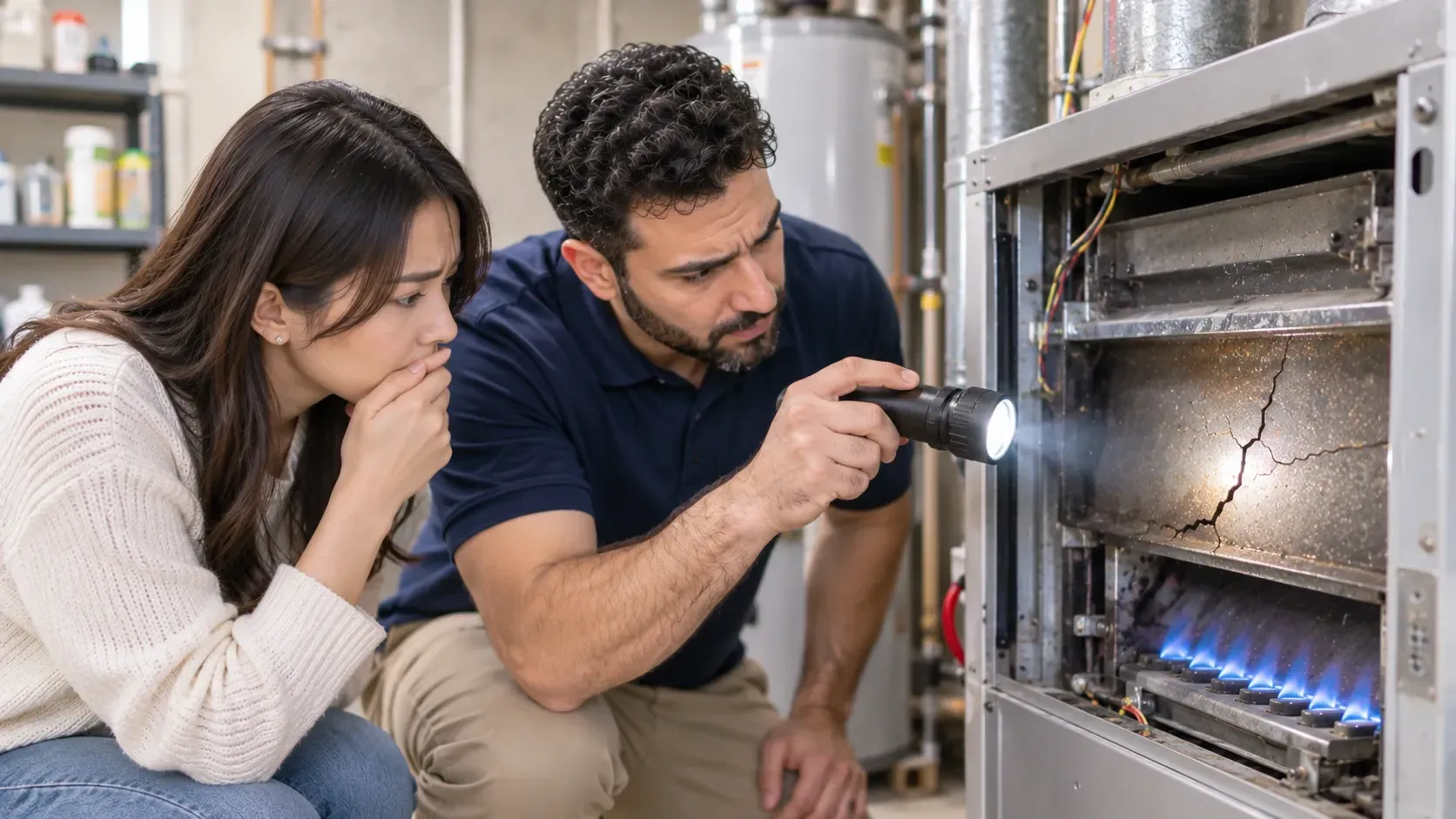
Table of Contents
- Introduction
- Why a Cracked Heat Exchanger Is a Carbon Monoxide Problem
- What the Heat Exchanger Actually Does
- Why a Furnace That Seems Fine Proves Nothing
- The Symptoms Worth Taking Seriously
- How a Crack Gets Found
- What Happens After a Crack Is Confirmed
- Conclusion
- Call Us for a Furnace Safety Inspection
- Frequently Asked Questions
Key Takeaways
- The heat exchanger is the wall between exhaust gases and the air you breathe.
- A crack puts a hole in that wall, and the blower distributes what comes through.
- Carbon monoxide has no color and no smell. An alarm is the only warning you get.
- Cracks open as the metal heats, so a furnace can test clean cold and leak hot.
- Ask to be shown the crack. A technician who found one can show you.
Introduction
No, and this is one of the few furnace problems where the honest advice is to stop using it tonight rather than wait for a convenient appointment, because a cracked heat exchanger can let combustion gases including carbon monoxide into the air your blower pushes through every room in the house, which is where the overheating cycle covered in our dirty filter post eventually ends up.
Most furnace faults cost you comfort or money. This one is in a different category, and it is worth understanding exactly why.
Why a Cracked Heat Exchanger Is a Carbon Monoxide Problem
Because of what the part is for. A furnace runs two separate air streams that must never meet.
The combustion side. The burner fires inside a sealed metal chamber. The flame consumes gas and air and produces exhaust, which includes water vapor, carbon dioxide and carbon monoxide. All of that is supposed to leave the building through the flue.
The house side. The blower pulls return air from your home and pushes it across the outside of that same metal chamber. The air picks up heat through the metal and carries it to the registers.
The heat exchanger is the wall between those two. Heat is supposed to cross it. Gas is not.
A crack is a hole in that wall. Once one exists, combustion products can cross into the house air stream, and the blower, doing exactly the job it was built for, distributes them evenly to every room you heat. That is the part people miss. It is not a leak into one corner of a basement. It is a distribution system working properly on the wrong input.
And carbon monoxide is the reason this matters more than the rest of it. It has no color, no smell and no taste. You cannot detect it by paying attention. Without a working alarm, there is no warning at all.
What the Heat Exchanger Actually Does
A short version, because the mechanism is covered in depth elsewhere.
Picture a folded metal chamber or a set of metal tubes inside the furnace cabinet. The burner fires into it, hot exhaust travels through its passages on its way to the flue, and house air flows around the outside picking up heat on the way past.
Why the metal eventually fails: it expands when hot and contracts when cool, every single cycle, for the life of the furnace. That is normal and designed for. What shortens it is excessive cycling or repeated overheating, which is the chain explained in our post on a furnace that short cycles rather than running proper burns.
Age does the rest. Corrosion from condensation, rust, and metal fatigue all accumulate, which is why cracks turn up far more often on older systems. If yours is well past the point where replacement warning signs start appearing, a cracked exchanger is one of the ways that conversation finally arrives.
Why a Furnace That Seems Fine Proves Nothing
This is the objection we hear every time, and it deserves a straight answer: "but it's heating the house fine."
It will. A crack does not stop a furnace working. The burner still lights, the blower still blows, the registers still deliver warm air, and heat transfer barely changes. Working and safety are two different questions, and only one of them can be settled from the hallway.
There is a second thing that makes this harder. Cracks move. Cold metal sits closed. As the furnace runs and the metal expands, a crack can open up, then close again as everything cools. So a furnace can look clean during a cold inspection and leak at operating temperature, which is one reason inspection has to happen with the system running rather than sitting.
And there is no smell to go on. The odor people associate with gas is an odorant deliberately added to the natural gas supply so leaks get noticed. It is not in the exhaust, and carbon monoxide carries nothing of its own. A furnace quietly putting combustion gas into your supply air smells exactly like a furnace.
The Symptoms Worth Taking Seriously
Some of these are about the equipment. The first two are about the people in the house, and they come first for a reason.
Stop and act on these immediately:
- A carbon monoxide alarm has sounded. Ever. Even once. Even if it stopped on its own.
- People feel unwell in a pattern tied to being home. Headache, dizziness, nausea, unusual tiredness, or something that feels like flu without a fever. The pattern that matters most is improvement after leaving the house and a return after coming back, and it is far more telling when more than one person is affected, or when a pet is unwell too.
If either of those is happening, get everyone out of the house and call 911 and your gas utility from outside. Do not go back in to investigate, open windows or look at the furnace. Carbon monoxide exposure needs medical assessment, and because the symptoms are so easily mistaken for a virus, tell the clinician you are concerned about CO specifically.
Equipment signs worth a call:
- Soot, or black and brown scorch marks on or around the furnace cabinet
- A burner flame that is yellow or orange and flickering rather than steady and blue
- A flame that visibly moves, rolls or changes shape the moment the blower starts
- A sharp chemical or acrid smell near the furnace while it runs
- Unusual condensation on windows near the furnace during a heating cycle
- Visible rust or flaking metal inside the cabinet
The flame-moving-when-the-blower-starts one is worth knowing. It suggests air crossing between the two sides that should be separated, and it is the kind of thing a homeowner can actually observe.
How a Crack Gets Found
Not by looking at the furnace, which is the first disappointment.
The exchanger lives inside the cabinet, and most of its surface is not visible without taking panels off and sometimes removing components. So the diagnosis is a technician's job, and it usually combines several of these:
- Visual inspection with the cabinet opened, using a mirror and light
- A borescope camera fed into the passages, which reaches the places a mirror cannot
- Watching flame behavior through a full cycle, including the moment the blower engages
- Combustion analysis, measuring what is actually in the flue gas
- Measuring for carbon monoxide in the supply air, which is the direct test of the thing you care about
- Pressure or smoke testing in some cases
Here is the part worth saying out loud, even though it is about our own trade. A cracked heat exchanger usually means replacing the furnace, which is a large expense, and that makes it a diagnosis with a sales incentive attached. So ask to be shown it. A borescope photograph, a video, the flame behavior demonstrated in front of you. A technician who has genuinely found a crack can show you the crack. If the answer is vague, getting a second opinion before spending thousands is reasonable and nobody honest will be offended by it.
What should not happen is being told to keep running it while you think about it.
What Happens After a Crack Is Confirmed
Three things, in this order.
Stop running it. Shut the furnace off at the switch, and at the gas shutoff if you know where it is and how. If you are not sure, ask the technician to do it or call the gas utility. A furnace that is off is not heating, which is inconvenient. It is the right kind of inconvenience.
Heat the house carefully in the meantime, and this matters. Electric space heaters are fine if they are kept clear of furniture and bedding and not run on extension cords. Never use an oven, a stove top, a grill, a camp stove, a generator or any unvented combustion appliance indoors for heat. That is a leading cause of carbon monoxide poisoning in houses where the furnace has already been shut off for safety, which is a grim irony and a real pattern.
Then look at the warranty before anybody quotes you. Heat exchangers frequently carry the longest manufacturer coverage of any component in the furnace, sometimes considerably longer than the rest of the unit. That does not mean free, because parts coverage and labor coverage are different things, but it can change the economics of repair versus replacement substantially. Find the model and serial number on the data plate before the conversation, not after.
Repair is occasionally possible and usually not practical. The exchanger is the core of the machine, the labor to reach it is most of the labor of replacing the furnace, and on a unit old enough to crack you are generally putting money into a system near the end of its life anyway.
Conclusion
If you have been told you have a cracked heat exchanger and the furnace is still running, turn it off tonight and sort the rest out tomorrow. If you suspect one, get it inspected with the system running and ask to see what the technician found. And whatever the outcome, put a working carbon monoxide alarm on every level of the house, because every argument in this article rests on the fact that you cannot detect the thing that matters without one. That alarm is the cheapest part of this entire subject.
Call Us for a Furnace Safety Inspection
If there is any chance your heat exchanger is cracked, shut the system down and let us look at it. Our furnace FAQ says the same thing: with a cracked heat exchanger, a gas smell or unusual carbon buildup, shut the system down until it is inspected. We will inspect with the system running, show you what we find, and give you an honest read on repair versus replacement. Flores HVAC & Construction has served Northern and Central California since 2000, holds two licenses, G-Builder and C20, LIC. #787079, and estimates are free. We are at 2393 Durham-Dayton Hwy in
Durham, and we cover
Chico homes and communities across Butte, Glenn, Colusa and Tehama counties. For
furnace repair call (530) 809-0058, email floreshvac2@gmail.com, or
call us through the site.
Frequently Asked Questions
Is it safe to run a furnace with a cracked heat exchanger?
No. A crack can let combustion gases including carbon monoxide into the air the blower circulates through the house. Shut the furnace off and have it inspected before it runs again, even if it appears to be heating normally.
Can a cracked heat exchanger leak carbon monoxide?
Yes, that is the central risk. The exchanger separates exhaust from the air you breathe. A crack lets them mix, and the blower then distributes whatever crosses over to every room the system heats.
How can I tell if my heat exchanger is cracked?
Usually you cannot, from outside the cabinet. Warning signs include a sounding CO alarm, soot, a yellow or flickering flame, a flame that moves when the blower starts, and people feeling unwell at home but better away from it.
Can a cracked heat exchanger be repaired?
Rarely in practice. Reaching it takes most of the labor of a full replacement, and cracks usually appear on furnaces already near the end of their life. Check the manufacturer warranty on the exchanger before deciding.
What should I do while the furnace is off?
Use electric heaters to keep well clear of anything flammable. Never heat a house with an oven, stove, grill, camp stove or generator. Unvented combustion indoors is a leading cause of carbon monoxide poisoning.