Can a Dirty Air Filter Actually Cause a Furnace to Overheat and Shut Down?
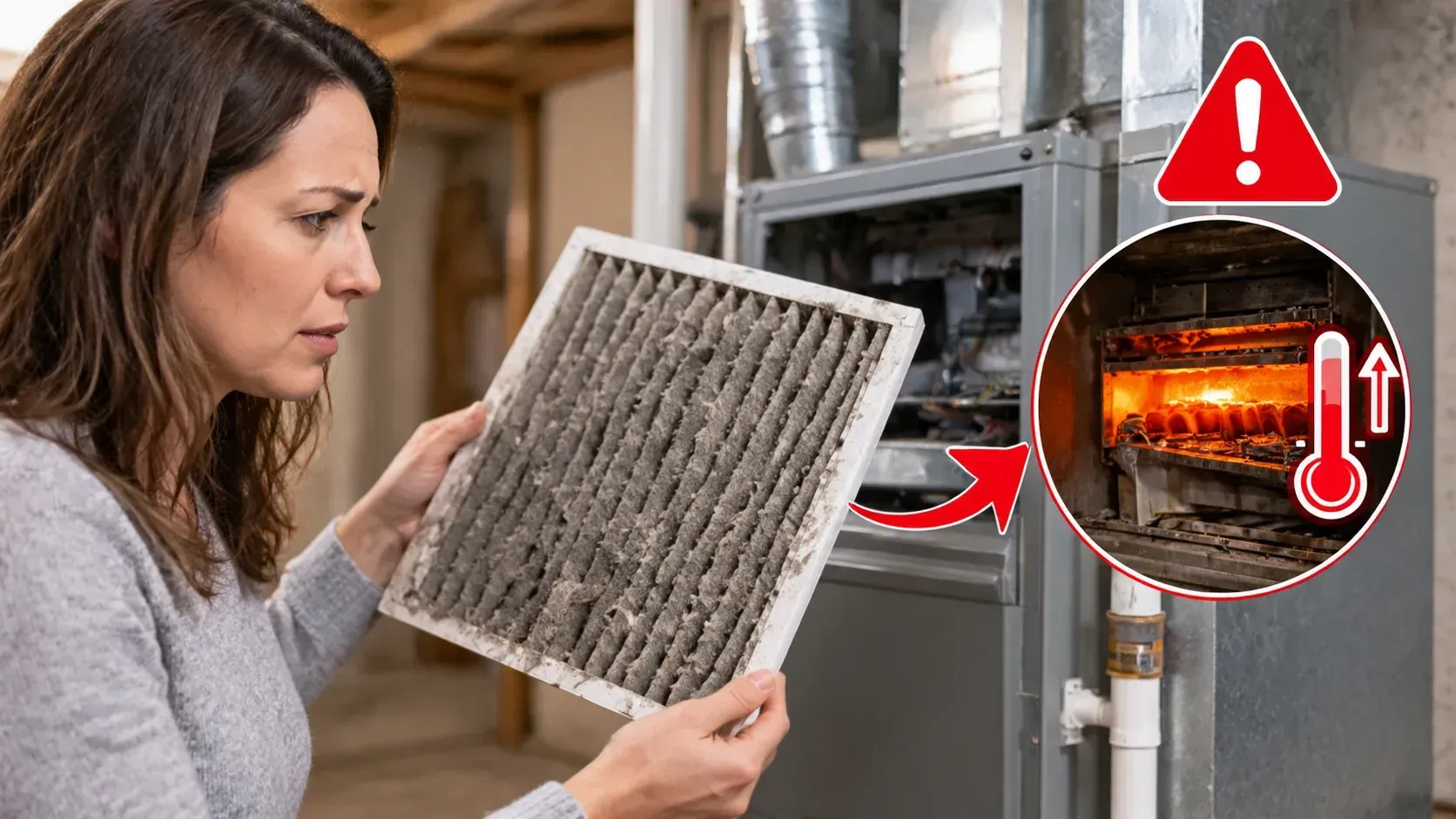
Table of Contents
- Introduction
- Yes, and Here Is the Mechanism
- Dirty Air Filter Furnace Problems Start With Airflow
- What Furnace Overheating Actually Trips
- How to Tell a Filter Problem From Something Worse
- Furnace Air Filter Problems You Can Prevent
- When a Clean Filter Does Not Fix It
- Conclusion
- Ask Us to Check the Filter and Safety Switches
- Frequently Asked Questions
Key Takeaways
- Yes. A severely clogged filter restricts airflow across the heat exchanger, and the heat that builds up can trip the furnace's high-limit safety switch.
- The shutdown is the furnace protecting itself, not the furnace failing.
- Repeated high-limit trips are what crack heat exchangers over time, which is the expensive version of this problem.
- A filter you cannot see light through is already restricting airflow, whatever the box said about its lifespan.
- If a clean filter does not fix it, the restriction is somewhere else in the system and needs a technician.
Introduction
Yes. A severely clogged air filter restricts airflow across the heat exchanger, and the resulting heat buildup can trip the furnace's high-limit safety switch, shutting the whole system down. The furnace is not broken when this happens. It is doing exactly what it was designed to do, which is stop producing heat it cannot move.
What makes this worth understanding is the part that follows. A furnace that trips its high limit once has a filter problem. A furnace that trips it every week for two winters has a heat exchanger problem coming, and that is a different conversation with furnace repair and replacement entirely.
Yes, and Here Is the Mechanism
A furnace makes heat in one place and has to move it somewhere else. The blower pulls air across the heat exchanger, the air picks up heat, and the ducts carry it into the house. That transfer is continuous and it is not optional.
Block the air and the heat has nowhere to go:
- The filter loads up with dust and the blower moves less air across the exchanger
- Less air means less heat carried away per minute
- Temperature inside the cabinet climbs past the design range
- The high-limit switch opens and cuts the burner
- The blower keeps running to purge the residual heat
- The cabinet cools, the limit resets, and the burner lights again
Then it repeats, which is why this often shows up as a furnace cycling on and off rather than as a furnace that simply quits. Airflow is one of several causes of that pattern, and the others are covered inwhat it means when a furnace keeps turning on and off every few minutes.
Dirty Air Filter Furnace Problems Start With Airflow
The filter is the most common restriction, but it is not the only one, and that distinction decides whether a new filter solves anything.
| Restriction | Where it sits | Fixable by a homeowner |
|---|---|---|
| Loaded air filter | At the return | Yes, in five minutes |
| Closed or blocked registers | Throughout the house | Yes |
| Furniture over a return grille | At the return | Yes |
| Crushed or disconnected duct | In the crawlspace or attic | No |
| Dirty blower wheel | Inside the air handler | No |
| Undersized return ductwork | Built into the house | No, this is a design fix |
The first three are worth checking before anything else. A homeowner who closes vents in unused rooms to save money is usually making the restriction worse, because the air that is no longer going into those rooms still has to go somewhere.
One more worth knowing: a filter that is too restrictive for the system can cause this even when it is clean. A very high MERV filter in a system that was not designed for it reduces airflow from the day it goes in.
What Furnace Overheating Actually Trips
The high-limit switch is the device doing the shutting down. It is a temperature-sensing safety mounted where it reads the air coming off the heat exchanger, and its job is to cut the burner before the exchanger gets hot enough to be damaged.
Two things follow from that.
First, the shutdown is good news in the moment. The safety worked. A furnace with a functioning high limit that trips on a dirty filter is a furnace that just avoided a much worse outcome.
Second, repeated trips are the actual damage. Every cycle of overheating and cooling expands and contracts the metal of the heat exchanger. Enough of those and the metal cracks. A cracked heat exchanger is a combustion-gas problem inside the airstream, and it generally means replacement rather than repair.
So the honest version of this answer is that a dirty filter does not break a furnace on Tuesday. It shortens the life of the most expensive component in the cabinet, quietly, over seasons.
How to Tell a Filter Problem From Something Worse
Check the filter first, because it costs nothing to rule out. A dirty air filter furnace shutdown and a genuine mechanical fault look identical from the hallway, and only one of them is free to eliminate.
Signs that point to the filter:
- The filter is visibly grey and light does not pass through it
- You cannot remember the last time it was changed
- The furnace runs fine for a while after each restart
- Airflow at the registers feels weak throughout the house
- Replacing the filter changes the pattern immediately
Signs that point elsewhere:
- The filter is genuinely clean and nothing improved
- Airflow is weak in some rooms and fine in others, which suggests duct problems
- There is a burning or metallic smell
- You hear a boom or rumble at ignition
- The furnace locks out and will not restart without a reset
- A carbon monoxide alarm has sounded at any point
That last one is not a troubleshooting item. Leave the house and call 911 and your gas utility from outside, then deal with the furnace afterward.
Furnace Air Filter Problems You Can Prevent
Check the filter monthly and replace it every one to three months, which is the interval this company already recommends on its maintenance guidance.
Practical habits that hold up:
- Write the install date on the filter frame in marker
- Check monthly during heating season rather than waiting for a reminder
- Shorten the interval with pets, allergies, dust, or construction nearby
- Match the filter size and rating to what the system was designed for
- Keep the return grille clear of furniture
- Keep supply registers open in every room
- Have the blower wheel and ducts looked at during annual service
Northern California adds its own pressure here. Agricultural dust through the valley and wildfire smoke seasons both load filters faster than a manufacturer's average interval assumes. The interval on the box is a starting point, not a schedule.
When a Clean Filter Does Not Fix It
If a new filter changed nothing, stop replacing parts and get the system measured. The restriction is real and it is somewhere you cannot see.
What a technician is looking for at that point:
- Static pressure across the system, which is the actual measurement of restriction
- Blower wheel condition and speed settings
- Duct sizing, crushed runs, and disconnected sections
- Whether the return is large enough for the equipment
- Whether the high-limit switch itself is faulty rather than correct
- Heat exchanger condition, if the trips have been going on a while
This is where a contractor who works on both the mechanical and construction side has an advantage, because undersized return ducts and a blocked plenum are building problems wearing a furnace problem's clothes. Flores HVAC and Construction holds both a general building and a C20 HVAC license, #787079, and has serviced Northern and Central California since 2000. Either way the first step is the same, which is measuring airflow rather than guessing at which component to swap.
Conclusion
A dirty filter really can shut a furnace down, and the shutdown is the system protecting itself rather than failing. Check the filter monthly, replace it on a real schedule rather than an optimistic one, and keep the returns and registers clear. If a clean filter does not change the pattern, the restriction is further in and it needs a measurement rather than another trip to the hardware store. The component you are protecting is the heat exchanger, and it is the one you cannot replace cheaply.
Ask Us to Check the Filter and Safety Switches
If your furnace has been shutting itself down, have the filter, the airflow, and the safety switches checked together rather than one at a time. Flores HVAC and Construction covers furnace service across Durham, Chico, Colusa, Biggs, Corning, Forest Ranch, Feather Falls, and the surrounding communities. Call (530) 809-0058 or
tell us what the furnace has been doing, and bring up the filter interval while a technician is there. Annual service is also where
the heat exchanger gets inspected.
Frequently Asked Questions
Can a dirty air filter cause a furnace to shut off?
Yes. A clogged filter restricts airflow across the heat exchanger, heat builds up inside the cabinet, and the high-limit safety switch cuts the burner to protect the system. Replacing the filter often restores normal operation within a cycle or two.
What is the high-limit switch on a furnace?
It is a temperature-sensing safety that shuts off the burner when air coming off the heat exchanger gets too hot. It exists to prevent heat exchanger damage. A limit that trips repeatedly is reporting a genuine airflow problem rather than malfunctioning.
Can a dirty filter damage a furnace permanently?
Not in one event, but repeated overheating cycles expand and contract the heat exchanger metal and can eventually crack it. A cracked heat exchanger usually means replacement rather than repair, which is why the cheap maintenance item protects the expensive component.
How often should a furnace filter be changed?
Check it monthly and replace it every one to three months for most homes. Shorten that with pets, allergies, heavy dust, or wildfire smoke. A filter you cannot see light through is already restricting airflow regardless of how long it has been installed.
Why did my furnace shut off even though the filter is clean?
The restriction is elsewhere. Blocked registers, a dirty blower wheel, crushed or disconnected ducts, or undersized return ductwork all reduce airflow the same way. A faulty high-limit switch is also possible. Measuring static pressure is what separates them.