What Does It Mean When Your Furnace Keeps Turning On and Off Every Few Minutes?
Table of Contents
- Introduction
- What Short Cycling Actually Is
- Why Your Furnace Keeps Turning On and Off
- Furnace Short Cycling From Restricted Airflow
- When the Unit Is Simply Oversized
- Furnace Troubleshooting You Can Do Safely
- When to Stop and Call a Technician
- Conclusion
- Schedule a Furnace Diagnostic Visit
- Frequently Asked Questions
Key Takeaways
- A furnace cycling on and off every few minutes is short cycling, meaning it shuts down before completing a full heating cycle.
- The most common causes are a clogged air filter, an oversized unit, a dirty flame sensor, or a thermostat problem.
- Short cycling is not just an annoyance. It burns more energy and puts wear on the ignition and blower components.
- The filter is the one cause a homeowner can rule out in five minutes.
- If the furnace locks out, smells of gas, or the carbon monoxide alarm sounds, stop troubleshooting and get help.
Introduction
A furnace that keeps turning on and off every few minutes is short cycling, which means it is shutting down before it finishes a full heating cycle. The usual causes are a clogged air filter restricting airflow, a unit oversized for the house, a dirty or failing flame sensor, or a thermostat that is misreading the room.
Each of those has a different fix and a different cost, which is why the symptom alone does not tell you much. What it does tell you is that the system is working harder than it should be, and that furnace repair and diagnostics will find the cause faster than guesswork will.
What Short Cycling Actually Is
Short cycling is a furnace starting a heating cycle and stopping it early, over and over. A healthy cycle runs long enough to bring the house to temperature and then shuts off on its own terms.
Normal behavior looks like longer runs with fewer starts. Short cycling looks like the opposite: the burner lights, runs briefly, shuts down, and restarts a few minutes later, repeating all evening without the house ever feeling warm.
It matters for three reasons:
- Energy. Startup is the least efficient part of any cycle, and short cycling is almost all startup.
- Wear. Ignition components and the blower motor wear by the cycle, not by the hour.
- Comfort. The house never settles, because the system never completes the job.
Worth knowing: a furnace cycling more often in very cold weather, or cycling briefly right at the start of the season, is not automatically short cycling. The pattern that matters is repeated short runs that never satisfy the thermostat.
Why Your Furnace Keeps Turning On and Off
Most cases trace back to one of five causes, and they are not equally likely.
| Cause | What is happening | How common |
|---|---|---|
| Clogged air filter | Restricted airflow causes heat to build up and the furnace to shut down on a safety | Most common |
| Dirty flame sensor | The sensor stops confirming flame, so the control board closes the gas valve | Common |
| Thermostat issue | Bad placement, failing wiring, or dead batteries make it misread the room | Common |
| Oversized furnace | The unit heats the space faster than the thermostat can keep up | Less common, but permanent |
| Blocked flue or exhaust | A pressure switch opens and shuts the sequence down | Less common, more serious |
The first three are repairs. The fourth is a sizing problem that no repair fixes. The fifth is a venting issue that needs attention promptly rather than eventually.
Furnace Short Cycling From Restricted Airflow
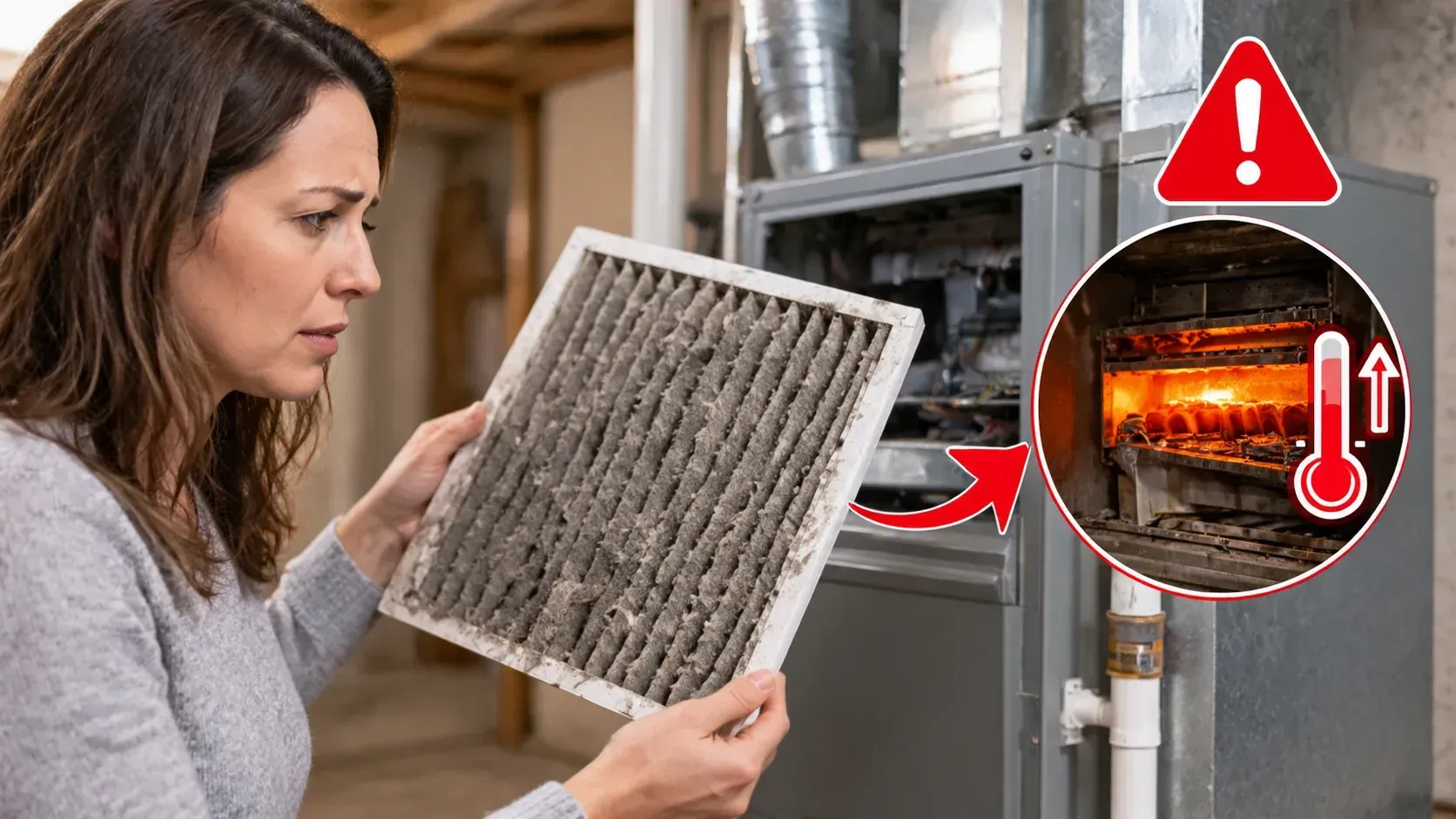
Restricted airflow is the leading cause, and the filter is usually the restriction. When air cannot move across the heat exchanger fast enough to carry heat away, the temperature inside the cabinet climbs and the furnace protects itself by shutting down.
Filters are not the only restriction. Also worth checking:
- Closed or blocked supply registers in unused rooms
- Furniture or rugs sitting over floor vents
- A closed return grille
- Crushed or disconnected flexible duct
- A dirty blower wheel, which is a technician's job
Closing vents to "save money in unused rooms" is a frequent and counterproductive culprit. It raises static pressure across the whole system, and the furnace feels that as restriction.
The full airflow-to-shutdown mechanism, including which safety device actually trips, is covered separately in whether a dirty filter can make a furnace overheat and shut itself down.
When the Unit Is Simply Oversized
An oversized furnace short cycles by design, and no repair changes that. This is the diagnosis nobody wants.
A unit with more capacity than the house needs blasts the space to temperature quickly, satisfies the thermostat, and shuts off before the system reaches steady operation. Then the house cools unevenly and it starts again. More capacity does not mean better heating.
Signs that point to sizing rather than a fault:
- The furnace has cycled this way since it was installed
- Rooms are uneven, with hot spots near the main supplies
- Nothing changed after a filter replacement and a tune-up
- The unit looks large for the square footage
Confirming it takes a proper load calculation rather than a rule of thumb. If it is confirmed, the practical options are a two-stage or variable-speed replacement, or duct and airflow changes that let the existing unit run longer.
Furnace Troubleshooting You Can Do Safely
Start with the filter, then the thermostat, then the vents. Everything past that belongs to a technician.
- Pull the filter and look at it against a light. If light does not pass through, that is your answer. Replace it and run the system.
- Check the thermostat. Fresh batteries, correct mode, and a setpoint that makes sense.
- Look at where the thermostat sits. Direct sun, a nearby lamp, a supply register blowing across it, or a drafty exterior wall will all make it misread.
- Open and unblock registers throughout the house, including rooms you do not use.
- Confirm the return grille is clear of furniture and filters stacked two deep.
- Check the outdoor exhaust and intake for a bird nest, leaf pack, or snow.
- Note the pattern before you call: how long it runs, how long it rests, and when it started.
Do not remove panels to reach the burner compartment, clean the flame sensor, or reset a tripped safety more than once. A safety that trips repeatedly is reporting a real condition, and bypassing it is how a nuisance becomes a hazard.
When to Stop and Call a Technician
Stop troubleshooting immediately if you smell gas or a carbon monoxide alarm sounds. Leave the house, then call 911 and your gas utility from outside. That is not an HVAC call.
Short of that, it is time for a professional when:
- A clean filter and a checked thermostat changed nothing
- The furnace locks out and needs a reset to restart
- You see error or flash codes on the control board
- There is a burning smell, a rumble, or a boom at ignition
- The pattern has been going on for more than a day or two
- The system has never run correctly since installation
Flores HVAC and Construction is licensed in both HVAC and general construction, License #787079, and has been servicing Northern and Central California since 2000, which matters here because sizing and duct problems sit on the construction side of the line as often as the mechanical side. The diagnostic step is the same either way: find the root cause before replacing parts.
Conclusion
Short cycling is a symptom with four or five realistic explanations, and the cheapest one is the most likely. Check the filter, check the thermostat, open the vents, and see whether the pattern changes. If it does not, the cause is inside the equipment or in the sizing, and both need somebody with a manometer rather than a guess. What you should not do is keep resetting a furnace that keeps shutting itself off. It is telling you something.
Schedule a Furnace Diagnostic Visit
If your furnace is cycling on and off and a new filter did not fix it, have it looked at before the first real cold snap. Flores HVAC and Construction will
track down the root cause rather than swapping parts across Durham, Chico, Colusa, Biggs, Corning, Forest Ranch, Feather Falls, and the surrounding communities. Call (530) 809-0058, Monday through Saturday, and we will help you assess the urgency.
Frequently Asked Questions
Why does my furnace keep turning on and off every few minutes?
That is short cycling, meaning the furnace shuts down before finishing a heating cycle. The usual causes are a clogged air filter, a dirty flame sensor, a thermostat misreading the room, or a unit oversized for the house. Start with the filter, since it is the quickest to rule out.
Is short cycling dangerous?
Usually it is a wear and efficiency problem rather than a safety one. It becomes a safety concern when a blocked flue or a repeatedly tripping safety switch is behind it. If you smell gas or a carbon monoxide alarm sounds, leave the house and call 911 and your gas utility.
Can a thermostat cause short cycling?
Yes. Dead batteries, failing wiring, or poor placement will all do it. A thermostat in direct sun, near a lamp, or in the path of a supply register reads warmer than the room and shuts the furnace off early. Moving it sometimes solves the whole problem.
Will replacing the air filter stop short cycling?
Often, if a restricted filter was the cause. Replace it, run the system through a few cycles, and watch the pattern. If nothing changes, the restriction is elsewhere or the cause is mechanical, and it needs a diagnostic.
How long should a furnace run per cycle?
Longer runs with fewer starts is the healthy pattern, and the exact length depends on the house, the weather, and the equipment. What matters is whether cycles end because the house reached temperature or because the furnace shut itself down early.